

Basalt vs Granite Pavers: 2026 Cost Comparison by Finish and Application
TL;DR: Basalt pavers typically run $10 to $40 per square foot installed, while granite pavers run $19 to $32. The exact number depends far more on finish and application than on the material itself. Driveways cost more than patios or walkways because they need a deeper compacted base to handle vehicle loads. Textured finishes like flamed and split-face tend to cost less. Honed and polished surfaces require more labor to produce. Below, this guide breaks down what actually drives the price. Use it to budget accurately before requesting a quote. Contact our team for current pricing on your specific project.
What Drives the Cost of Basalt and Granite Pavers?
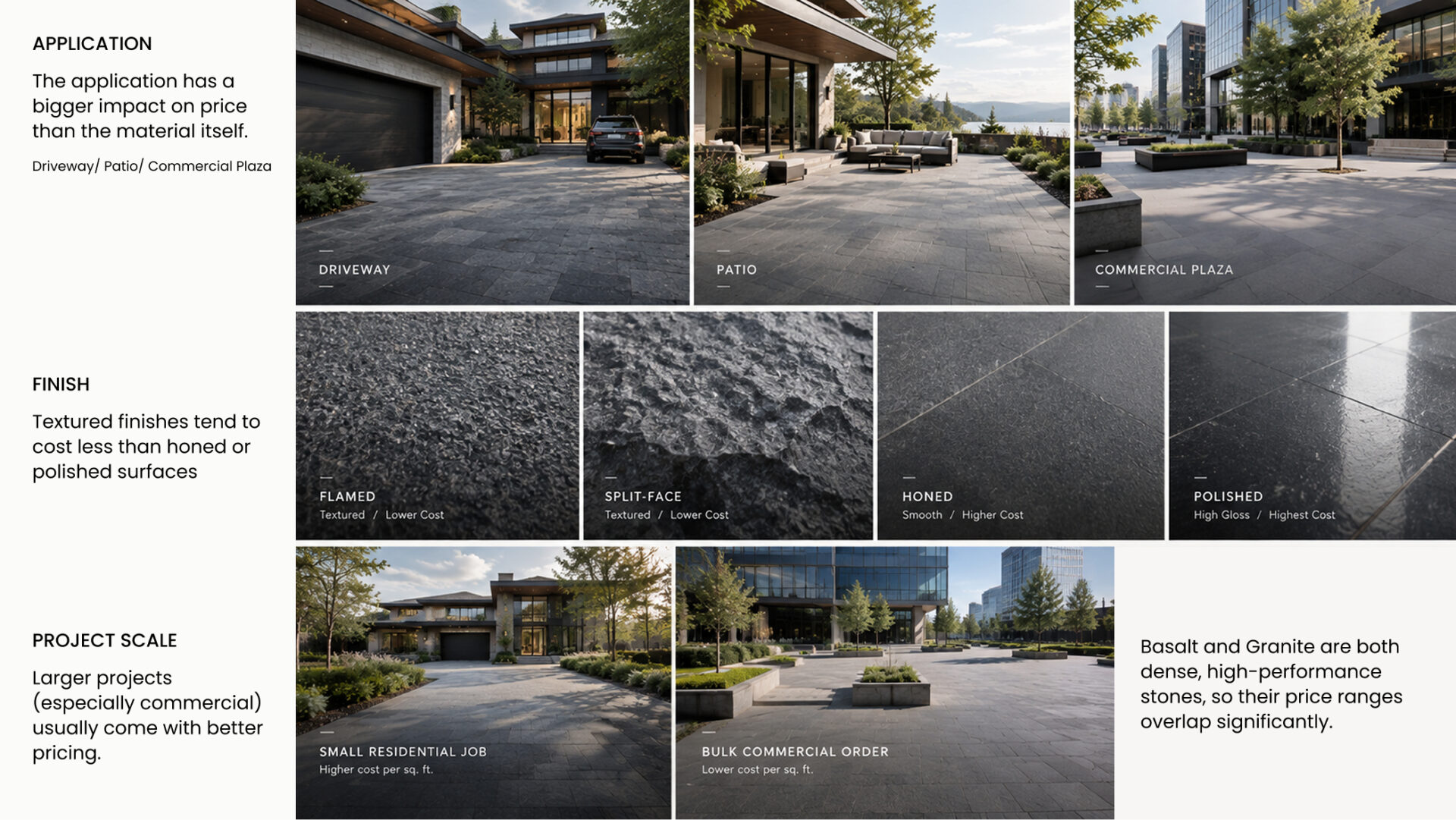
Three factors matter more than the material choice itself. Application comes first: driveway, patio, or commercial plaza. Finish comes next, whether textured or polished. Finally, project scale ranges from a small residential job to a bulk commercial order. Basalt and granite are both dense, high-performance stones, so their price ranges overlap significantly. The real budgeting question usually isn’t “basalt or granite.” Instead, it’s “what finish, what base preparation, and what quantity.”
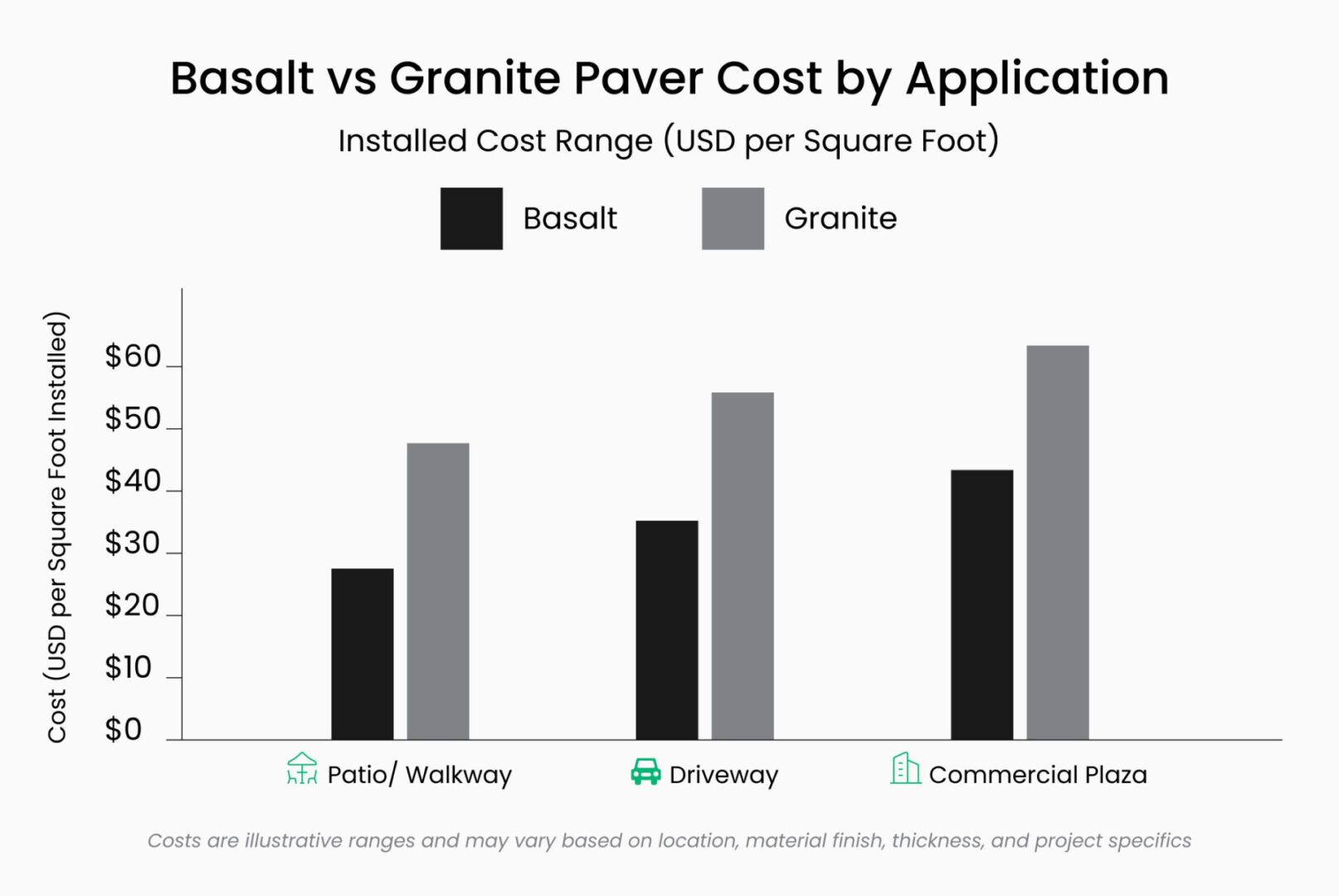
Basalt vs. Granite Paver Cost by Application
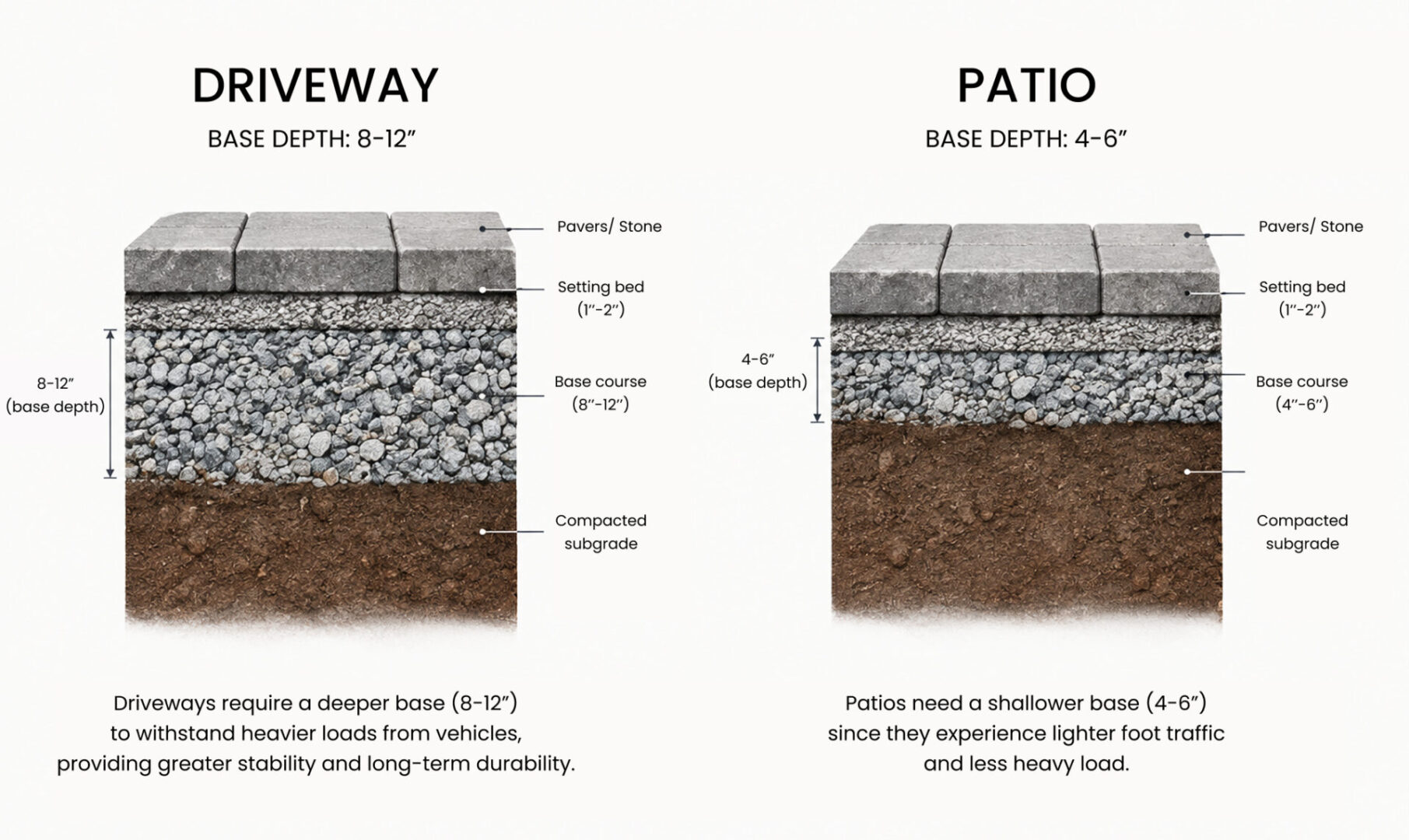
Paver cost per square foot varies by where it’s being installed, mainly because of how deep the compacted base needs to be. A patio or walkway generally needs 4 to 6 inches of compacted base, while a driveway needs 8 to 12 inches to support the repeated weight and turning pressure of vehicles. That difference in base depth (not the stone itself) is a major reason driveways cost more per square foot than patios using the identical paver.
| Application | Typical Installed Cost Range | Why |
| Patio or Walkway | Toward the lower-to-middle of the overall range (roughly $15–$28/sq. ft. for basalt or granite) | Shallower base depth (4–6″), primarily foot traffic |
| Driveway | Toward the middle-to-upper end of the overall range (roughly $20–$40/sq. ft. for basalt or granite) | Deeper compacted base (8–12″) required to handle vehicle loads |
| Commercial Plaza / Streetscape | Priced per project, not a flat per-square-foot rate | Bulk material discounts are common, but engineered sub-base, slip-resistance specs, and ADA compliance requirements can offset those savings |
For general reference, basalt pavers run roughly $10 to $40 per square foot installed depending on finish and thickness, granite pavers run about $19 to $32 per square foot, and general natural stone paver installation averages $18 to $24 per square foot nationally. Commercial and municipal projects are typically quoted per project rather than off a flat rate, since specifications like slip-resistance ratings and structural sub-base requirements vary by jurisdiction.
How Finish Affects Basalt and Granite Paver Cost
Finish has a bigger effect on price than most buyers expect, because some finishes require far more labor to produce than others. This pattern shows up consistently across dimension stone pricing in general, for example, published cost data for bluestone (a closely related dimension stone) shows natural cleft/split-face finishes running noticeably cheaper than thermal/flamed finishes, which in turn cost less than honed or polished surfaces. The same general hierarchy applies to basalt and granite:
| Finish | Relative Cost | Why |
| Split-Face / Natural Cleft | Lowest | Stone is split along natural seams rather than cut and processed; minimal labor |
| Flamed / Thermal | Low-to-moderate | Heat-treated for texture and slip resistance; more processing than split-face but still efficient to produce |
| Bush-Hammered | Moderate | Mechanically textured surface; more labor-intensive than flamed |
| Honed | Moderate-to-high | Sanded to a smooth matte finish through multiple grit passes |
| Polished | Highest | Requires the most processing steps to achieve a glossy, reflective surface |
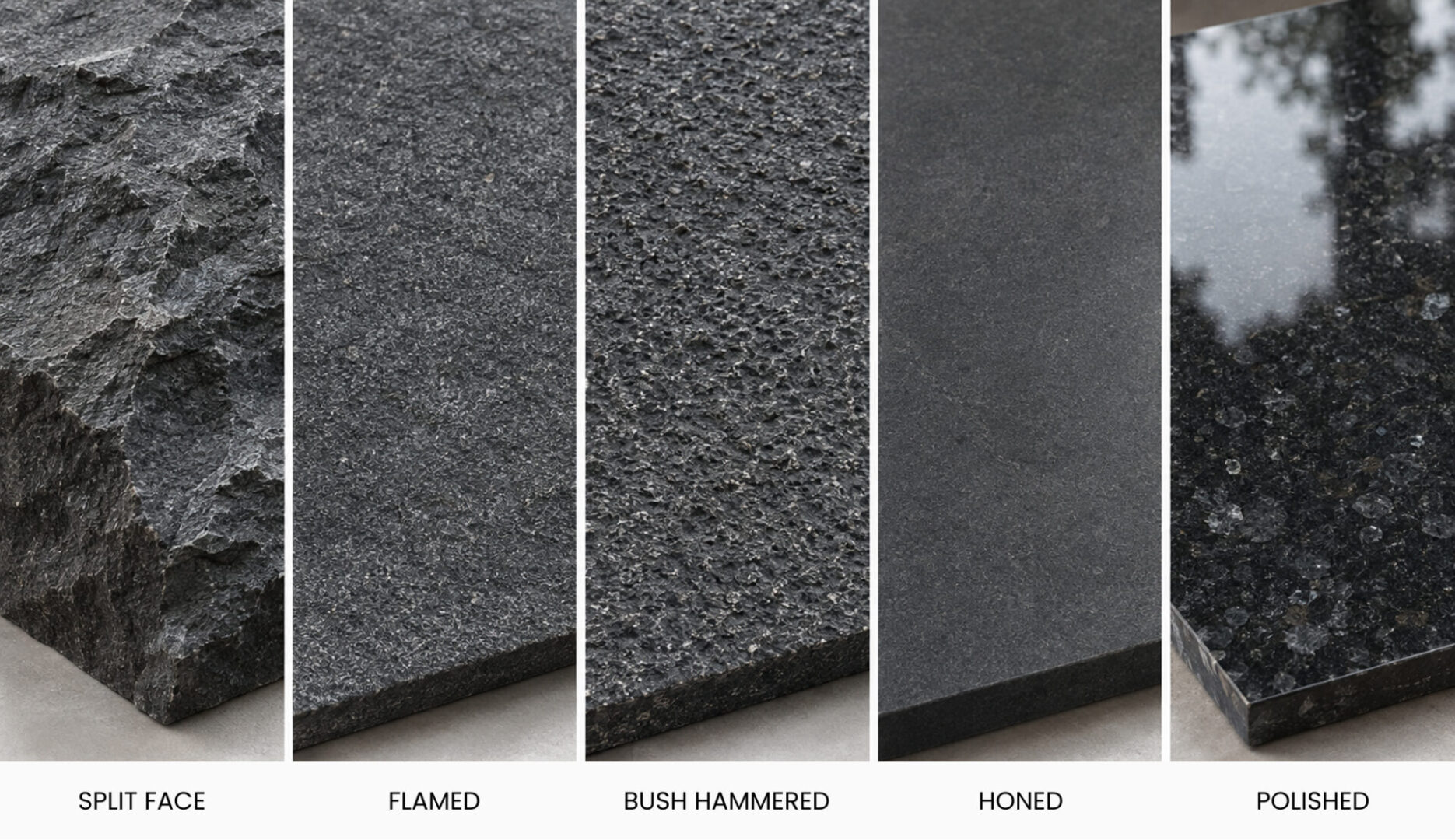
For exterior paving specifically, flamed and bush-hammered finishes are the most common choice regardless of budget, since they combine reasonable cost with the slip resistance that driveways, walkways, and pool decks need. Polished finishes are rarely used outdoors for this reason and are better suited to interior floors and countertops.
Basalt and Granite vs. Other Paving Materials
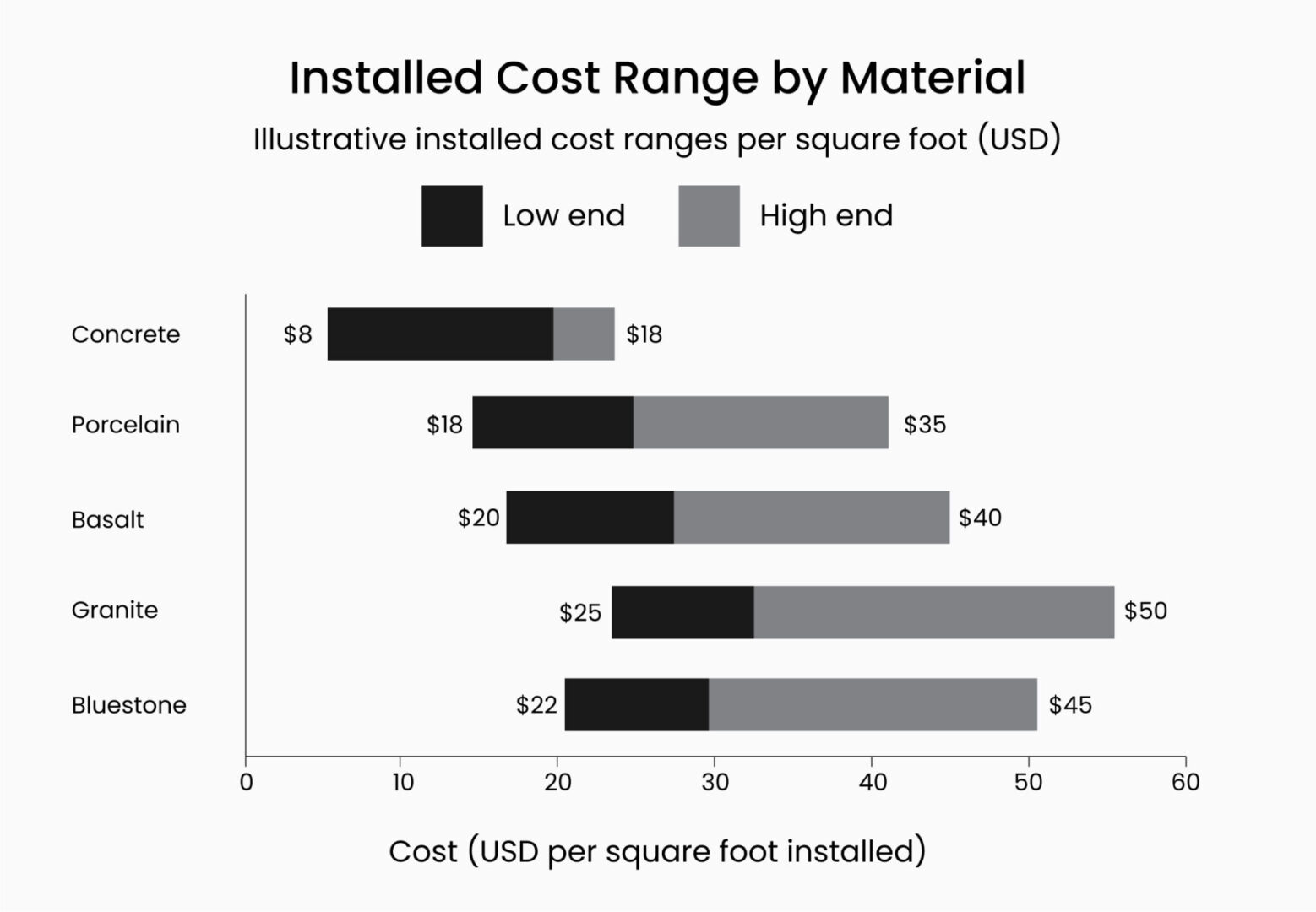
For context, here’s how basalt and granite pavers compare to the other materials most commonly cross-shopped against them:
| Material | Typical Installed Cost | Notes |
| Concrete pavers | ~$5–$15 per sq. ft. | Lowest upfront cost; shorter service life and less resistance to heavy use |
| Porcelain pavers | ~$7–$25 per sq. ft. | Durable and low-maintenance, but lacks the natural color variation of basalt or granite |
| Basalt pavers | ~$10–$40 per sq. ft. | Uniform, modern charcoal-to-black appearance; strong freeze-thaw performance |
| Granite pavers | ~$19–$32 per sq. ft. | Widest natural color/pattern range; excellent durability for high-traffic areas |
| Bluestone / flagstone | ~$15–$32 per sq. ft. | Softer and more porous than basalt or granite; needs more frequent sealing |
Basalt and granite sit at the higher end of the paving-material spectrum, but that upfront premium reflects meaningfully longer service life and lower long-term maintenance compared to concrete, which is worth weighing against the lower sticker price.
Does Quarry Origin or Order Size Affect the Price?
Two other factors shift the final number more than most buyers expect: where the stone is quarried, and how much of it is being ordered.
Quarry origin matters most for granite. Because granite’s biggest selling point is its color and pattern range, rarer colors carry a real price premium. The same principle that pushes unique granite countertop slabs toward $100 to $200+ per square foot while standard grays and blacks stay closer to $40 to $100. Basalt, by contrast, has a much narrower natural color range (charcoal to black), so quarry origin affects basalt pricing mainly through shipping distance and lead time rather than color rarity.
Order size affects both materials similarly. Because basalt and granite pavers are quarried and finished to order rather than mass-manufactured, larger orders typically unlock better per-square-foot pricing, while small or highly custom orders (unusual sizes, mixed finishes, tight timelines) tend to cost more per unit. This is one reason why working directly with a quarry-direct supplier (rather than a reseller adding a markup at each step) matters more for basalt and granite than it does for manufactured materials like concrete or porcelain pavers, where the pricing is far less sensitive to sourcing structure.
Regional labor costs also move the installed price, independent of the stone itself. Site preparation, base compaction, and skilled masonry labor for natural stone installation vary significantly by region across the U.S. and Canada, which is part of why every cost range in this guide is presented as a range rather than a single number. The material cost is only part of the final invoice.
Hidden Costs to Budget For
A few line items catch buyers off guard if they’re not factored in early:
- Sub-base preparation. Grading, excavation, and compacted base material can add $9 to $17 per square foot in labor alone, on top of the paver cost itself, and driveways need substantially more of it than patios.
- Sealing. A penetrating sealer isn’t usually included in the base installed price and is worth budgeting for separately, along with reapplication every few years.
- Delivery and lead time. Because basalt and granite are quarried and finished to order rather than stocked off the shelf, larger or custom orders should account for shipping lead time, particularly for imported stone when planning a project timeline.
- Site-specific factors. Difficult access, unusual site grading, or tight project timelines can all shift the final number away from a generic per-square-foot estimate.
How to Get an Accurate Quote for Your Project
Because so much of the final cost depends on application, finish, and order size rather than the raw material, a generic per-square-foot number can only get a budget so far. The fastest way to get a real figure is to contact our team with your project’s specifics: square footage, intended use (driveway, patio, or commercial plaza), and your preferred finish. For a deeper look at the performance trade-offs behind the cost, see Basalt vs. Granite Pavers: Which Is Better for Heavy Traffic Areas? or explore the basalt and granite finish galleries directly.
FAQ
Is basalt or granite more expensive?
Their price ranges overlap significantly. Basalt runs roughly $10 to $40 per square foot installed and granite roughly $19 to $32 per square foot. Finish and application affect the final cost more than the choice between the two materials.
Why do driveways cost more than patios for the same paver?
Driveways need a deeper compacted base, typically 8 to 12 inches versus 4 to 6 inches for a patio, to support vehicle weight and turning pressure. That extra base preparation adds cost independent of the paver itself.
Which finish is cheapest for basalt or granite pavers?
Split-face and flamed finishes are generally the most cost-effective, since they require less processing than honed or polished surfaces. They’re also the most practical choice for exterior paving due to their slip resistance.
Do commercial or bulk orders get a lower price per square foot?
Often yes, but commercial and municipal projects also tend to carry additional requirements like engineered sub-base, specific slip-resistance ratings, ADA compliance. All those can offset bulk savings. These projects are typically quoted per project rather than at a flat rate.
What should I budget for beyond the paver cost itself?
Sub-base preparation and labor, sealing, and delivery lead time for custom or imported orders are the most common costs buyers forget to include in an initial budget.
CONTACT OUR TEAM FOR PRODUCT INFORMATION, SAMPLES OR PRICING
