

Granite vs Basalt for Commercial Plazas: A Specifier’s Comparison
TL;DR: In a granite vs basalt commercial plaza decision, both stones perform well, but they diverge on a few points that matter to specifiers. Granite has a dedicated ASTM material specification (C615), while specifiers evaluate basalt under general dimension-stone test methods instead. Granite’s lighter color options also reduce solar heat gain in ways basalt’s charcoal-to-black palette cannot. Both stones need textured finishes to deliver dependable slip resistance on accessible pedestrian routes. Below, this guide breaks down the technical differences that should drive a specification decision. Download our stone catalogues or contact our team for mill-certified data on a specific project.
Why a Granite vs Basalt Commercial Plaza Choice Matters for Specifiers
A granite vs basalt commercial plaza decision isn’t really a stylistic choice, the way it might be for a residential patio. It’s a specification decision with real liability, accessibility, and lifecycle implications attached. Slip-and-fall risk, ADA compliance, and long-term wear all carry legal and budgetary weight that residential projects generally don’t. That’s why this comparison focuses on the technical criteria a specifier actually has to document, rather than aesthetic preference alone.
Granite vs Basalt Commercial Plaza Slip Resistance and ADA Requirements
ADA Standard 302.1 requires floor and ground surfaces along accessible routes to be stable, firm, and slip resistant. The ADA standards don’t set a minimum coefficient of friction, though. No consensus test method rates slip resistance for every surface under every condition.
Many specifiers therefore reference ANSI A326.3 as a practical benchmark. It measures the Dynamic Coefficient of Friction (DCOF) of hard surface flooring with a tribometer, and its product use classifications include an exterior wet category. The standard also cautions that a DCOF value shouldn’t be the only factor in judging a material for a given application. Because it covers hard surface flooring, confirm with your testing lab how it applies to textured natural stone.
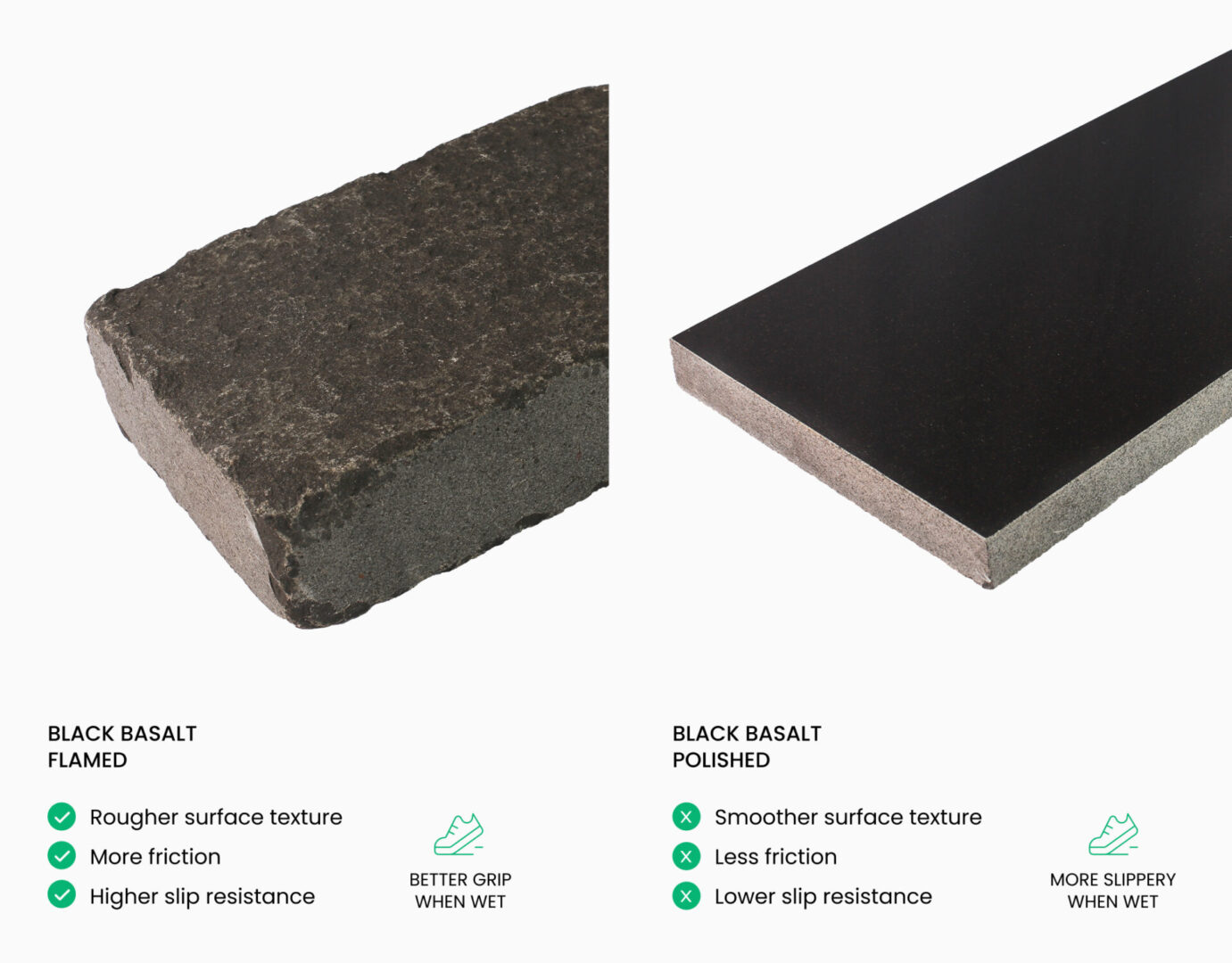
In any granite vs basalt commercial plaza comparison, the finish matters more than the stone. Specifiers choose textured finishes — flamed, bush-hammered, or sandblasted — for exterior pedestrian paving to maximize traction. Polished finishes rarely suit this application in either material.
ADA also sets hard tolerances that apply regardless of stone type. Vertical changes in level up to 1/4 inch don’t need an edge treatment. Changes between 1/4 and 1/2 inch must be beveled, and anything greater requires a ramp. Joint width and paver lippage tolerances need a place in the installation spec for granite and basalt alike. The material doesn’t change these numbers, but sloppy installation of either stone can push a compliant surface out of compliance.
Abrasive Hardness and Wear: Which Material Holds Up Longer
Both granite and basalt sit at the top end of the hardness scale for common building stones. Granite often scores 6 to 7 on the Mohs scale; basalt typically scores 5 to 7. Both comfortably clear the abrasive hardness minimums needed for heavy-traffic commercial flooring.
ASTM C615 already establishes a documented floor for granite. Basalt hardness varies more by quarry and mineral composition, so specifying basalt for a high-traffic plaza requires mill-certified hardness data. This is where the two materials diverge.
Heat Performance: Granite vs Basalt in a Commercial Plaza
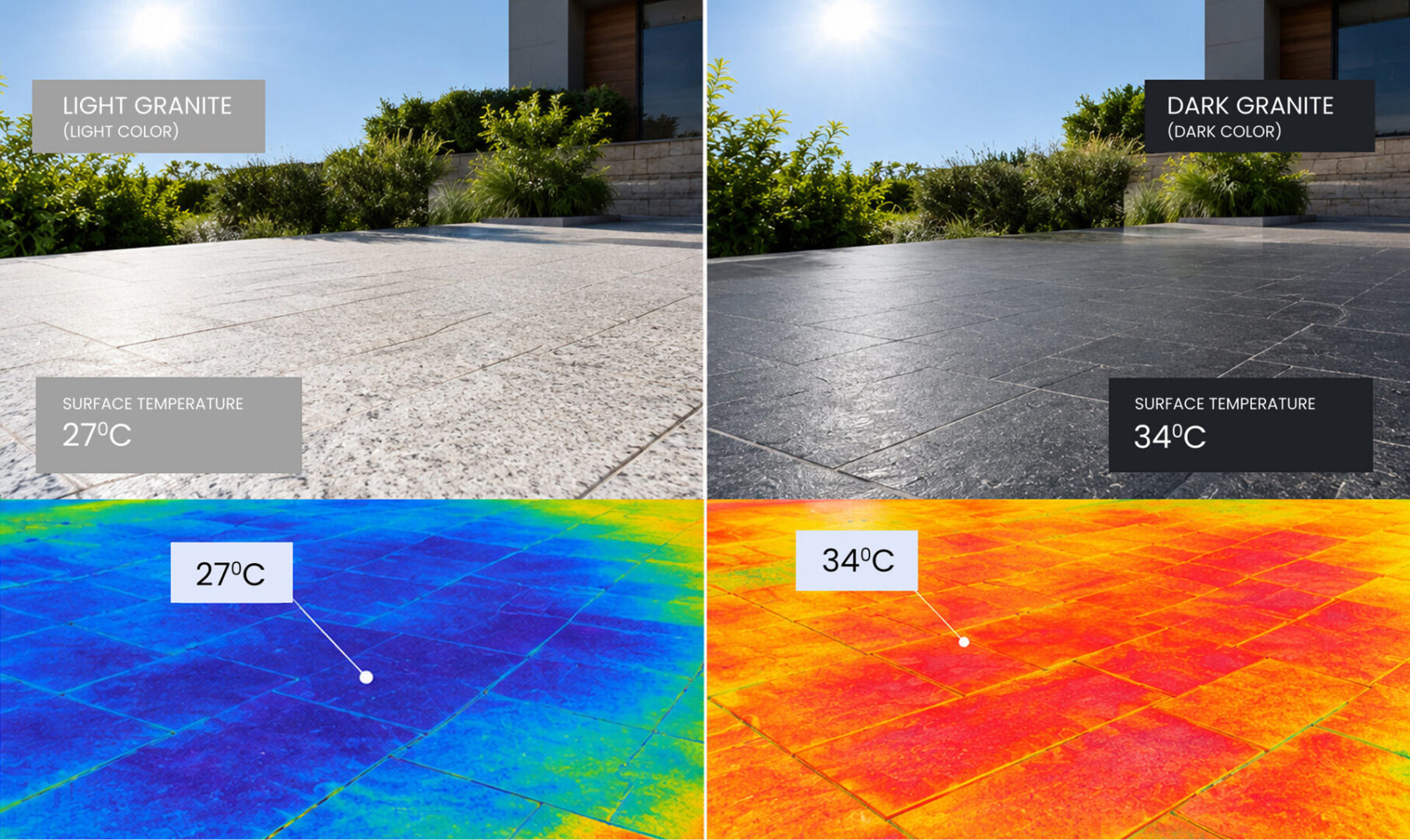
This is one of the more overlooked differences between the two materials in an urban plaza context. Light-colored granite reflects significantly more solar energy than dark stone. That keeps the surface cooler underfoot and reduces the paving’s contribution to the urban heat island effect. The EPA describes cool pavements as paving materials that reflect more solar energy and stay cooler than conventional pavements — a real consideration for public plazas subject to sustainability review or LEED-adjacent scoring.
Basalt’s charcoal-to-black color, by contrast, absorbs more solar energy and runs measurably hotter underfoot on a sunny day. This is worth flagging early for any plaza in a climate with significant summer sun exposure, or for any project where heat island mitigation is part of the design brief.
 Heat and Urban Heat Island Consideration
Testing Standards: ASTM C615 vs General Dimension-Stone Testing
This is a distinction specifiers should know about before writing a granite vs basalt commercial plaza spec sheet. Granite has its own dedicated ASTM material specification, ASTM C615. It sets documented requirements for absorption, density, compressive strength, modulus of rupture, abrasion resistance, and flexural strength — specifically for granite dimension stone in cladding, paving, curbing, and structural applications.
Basalt has no equivalent basalt-specific ASTM material specification. Specifiers instead evaluate it using the same general test methods used across dimension stone: ASTM C97 (absorption and density), C99 (modulus of rupture), and C170 (compressive strength). No single standard ties those results together into one basalt-specific benchmark the way C615 does for granite.
In practice, this means a granite spec can cite ASTM C615 compliance directly. A basalt spec, on the other hand, needs to reference the individual test methods (C97, C99, C170) and request mill-certified results against each one. Neither approach is a red flag; basalt performs excellently against these individual tests. It does mean a basalt spec sheet takes a bit more assembly than a granite one. Request that documentation early in the procurement process, rather than after a bid has already gone out.
Cost and Lifecycle Considerations at Commercial Scale
At commercial volume, granite and basalt pricing tends to converge more than the residential cost ranges suggest. That’s because bulk material discounts apply to both. What tends to differentiate the total project cost is engineering requirements layered on top of the material. ADA-compliant sub-base engineering, drainage planning, and detectable warning surfaces at curb transitions apply regardless of which stone you choose. As a result, the material line item is often a smaller share of the total budget than architects unfamiliar with stone procurement might expect.
Both materials offer a long service life with minimal maintenance once installed. That’s the stronger lifecycle argument for either one over asphalt or standard concrete in a high-visibility public space.
Procurement and Lead Time for Large Orders
Commercial-scale plaza projects typically involve custom order sizes, specific finish requirements, and tighter delivery windows than residential jobs. That makes supplier selection matter as much as material selection. Sourcing through a supplier with direct, vetted relationships across quarries and factories, rather than through a reseller, generally means more predictable lead times and tighter quality control across a large order. Fewer intermediaries means fewer chances for delays or inconsistency between pallets. For any commercial bid, request lead time estimates and mill certifications at the RFP stage. Don’t assume standard residential turnaround times will apply.
Decision Matrix: Which Stone Fits Which Commercial Plaza
The table below summarizes how a granite vs basalt commercial plaza choice plays out across common project priorities, based on the technical differences covered above.
| Project Priority | Better Fit | Why |
| Urban heat island mitigation / hot climate |
Granite (lighter colors) | Reflects more solar energy, stays cooler underfoot |
| Documented ASTM material compliance |
Granite | ASTM C615 provides a single, granite-specific benchmark |
| Uniform, modern, monochromatic aesthetic | Basalt | Consistent charcoal-to-black appearance across a large area |
| Budget-conscious bulk order | Either, priced per project | Bulk discounts apply to both; engineering costs often matter more than material choice |
| Cold-climate freeze-thaw exposure | Either | Both perform well; request mill-certified absorption data either way |
FAQ
Is granite or basalt better for ADA-compliant plazas? Both can support the ADA’s slip-resistant surface requirement with the right textured finish. Compliance depends more on finish selection and installation tolerances than on which material you choose.
Which material stays cooler in direct sun? Lighter-colored granite reflects more solar energy and stays cooler underfoot than basalt, whose charcoal-to-black color absorbs more heat. This matters most in hot climates or projects with urban heat island mitigation goals.
Does basalt have its own ASTM specification like granite’s C615? No. Granite has a dedicated ASTM material specification (C615). Specifiers evaluate basalt using general dimension-stone test methods (C97, C99, C170) instead of a single basalt-specific standard.
Is one material significantly cheaper for large commercial orders? Not usually. At commercial volume, bulk discounts apply to both materials. Engineering requirements like sub-base preparation and drainage often account for more of the total budget than the choice between granite and basalt.
What should be requested at the RFP stage? Request mill-certified test data (absorption, compressive strength, abrasion resistance), documented lead times, and finish samples for slip-resistance testing from the supplier before finalizing a bid, not after.
Conclusion & Next Steps
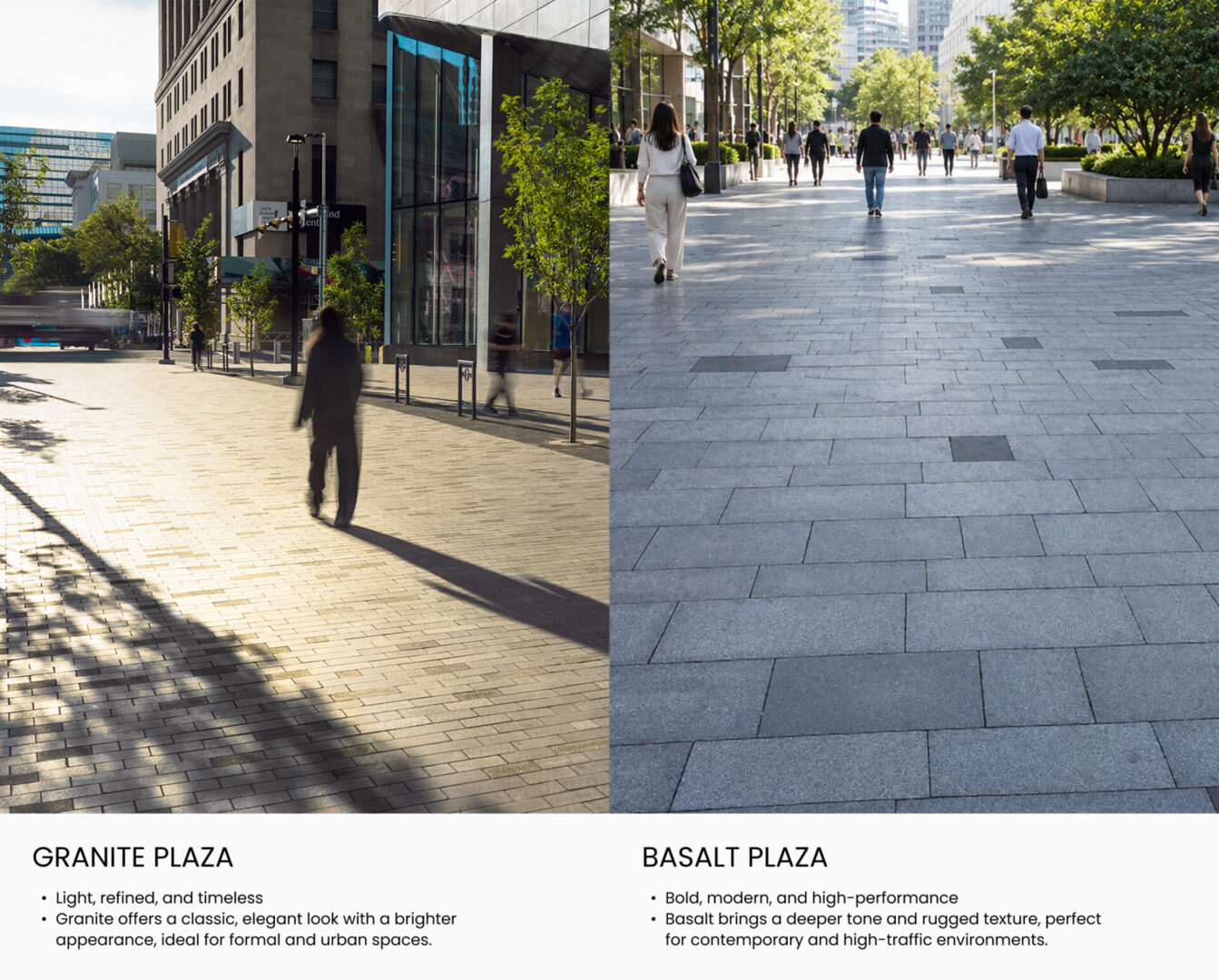
Overall, a granite vs basalt commercial plaza decision comes down to climate, documentation requirements, and aesthetic goals rather than one material being categorically better than the other. Granite offers a documented ASTM specification and cooler-running light color options. Basalt offers a uniform modern appearance backed by solid, if less centrally codified, test data.
Download Reidstone’s stone catalogues for mill-certified specifications on both materials, or contact our team to discuss lead times and documentation for your next commercial bid.
CONTACT OUR TEAM FOR PRODUCT INFORMATION, SAMPLES OR PRICING
