

Is Basalt More Durable Than Granite? A Side-by-Side Performance Breakdown
TL;DR: Neither stone is categorically “more durable.” Basalt and granite overlap significantly across compressive strength, water absorption, and abrasion resistance. The exact numbers depend more on the specific quarry and grade than on which stone type you choose. Basalt tends to edge ahead on water absorption and freeze-thaw resistance; granite tends to offer a wider strength range at the premium end. For most paving and cladding applications, both perform excellently. The more useful question is which stone’s specific tested numbers fit your project’s requirements. Contact our team for certified data.
What “Durability” Actually Means for Stone
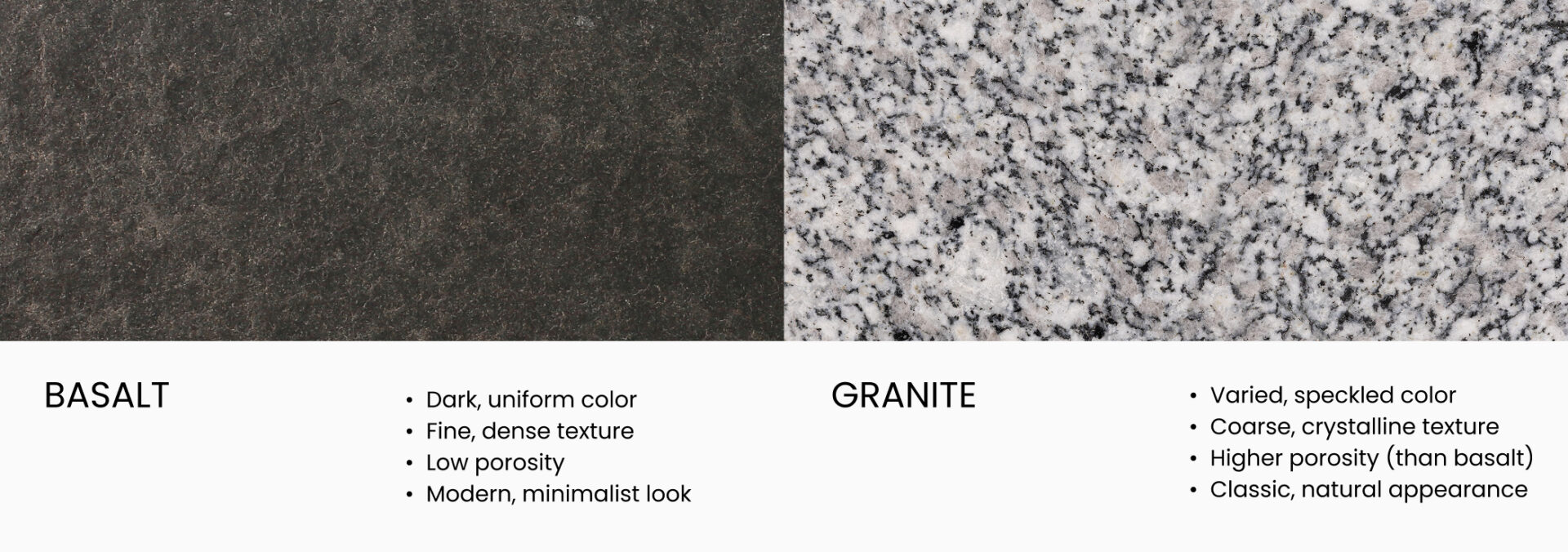
People treat “durability” as a single catch-all word, but it’s really shorthand for several distinct properties. Compressive strength measures resistance to crushing under load. Water absorption measures resistance to moisture penetration, which drives freeze-thaw damage. Abrasion resistance measures resistance to surface wear from foot or vehicle traffic. Density reflects overall structural stability. A stone can rank ahead on one of these and behind on another. That’s exactly the case with basalt and granite.
Compressive Strength: Basalt vs. Granite
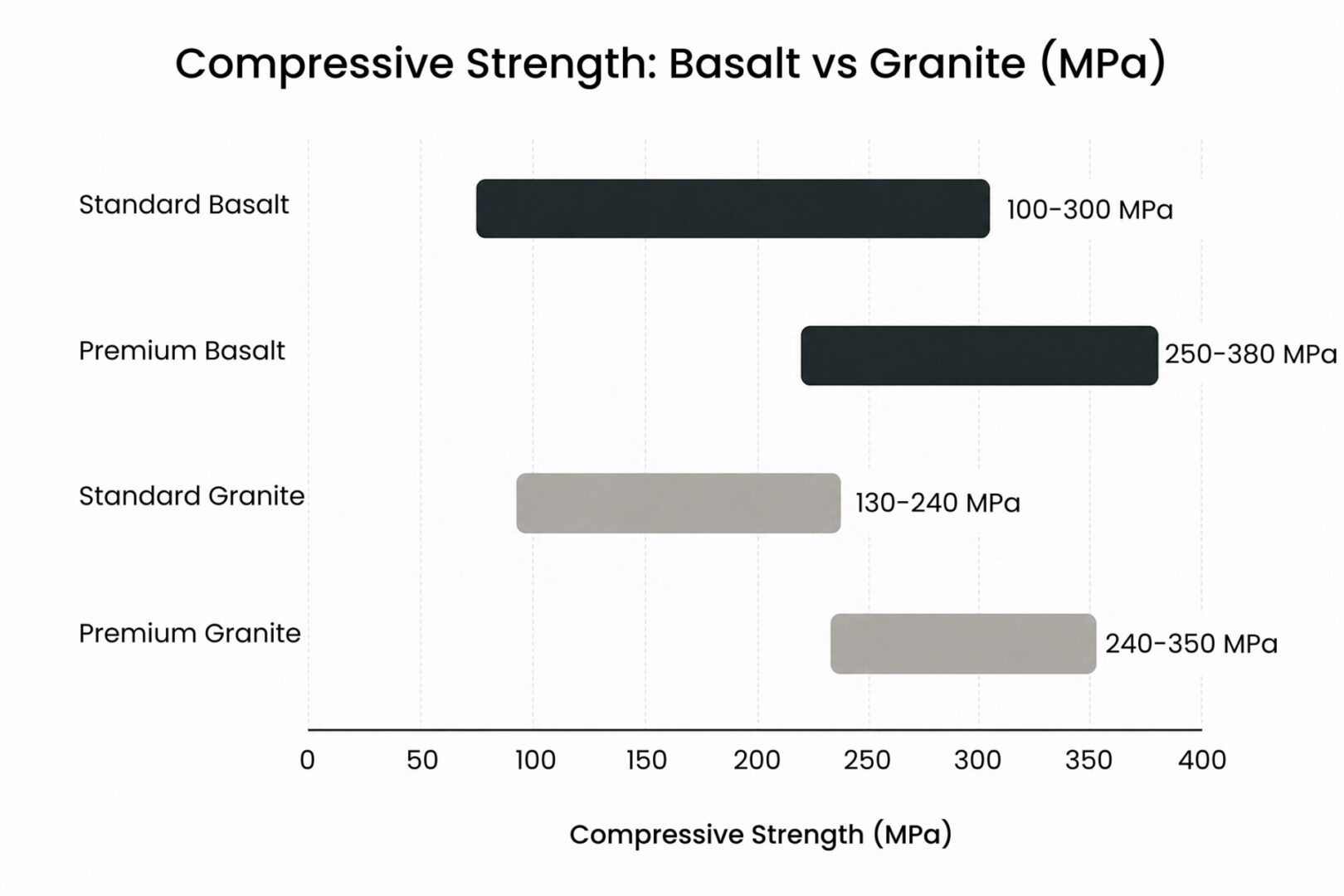
Compressive strength measures how much load a stone can bear before it crushes, tested under ASTM C170. Industry-standard ranges put basalt at roughly 100–300 MPa and granite at roughly 130–240 MPa, figures that overlap substantially rather than showing a clear winner.
Where this gets more interesting is at the premium end of each category. Our own basalt and granite product lines illustrate the point well: premium black basalt pavers and tile test at 250–380 MPa, exceeding even our strongest black granites like Zorra (250–300 MPa) and Soho (240–270 MPa). Meanwhile, standard-grade granites in warmer tones – reds, greys, and pinks – typically run 170–220 MPa, comparable to mid-range basalt.
The honest takeaway: compressive strength is driven far more by the specific quarry and grade than by the basalt-versus-granite distinction alone. A premium basalt can out-perform a standard granite, and vice versa.
Water Absorption and Freeze-Thaw Resistance
This is where basalt tends to have a genuine, consistent edge.
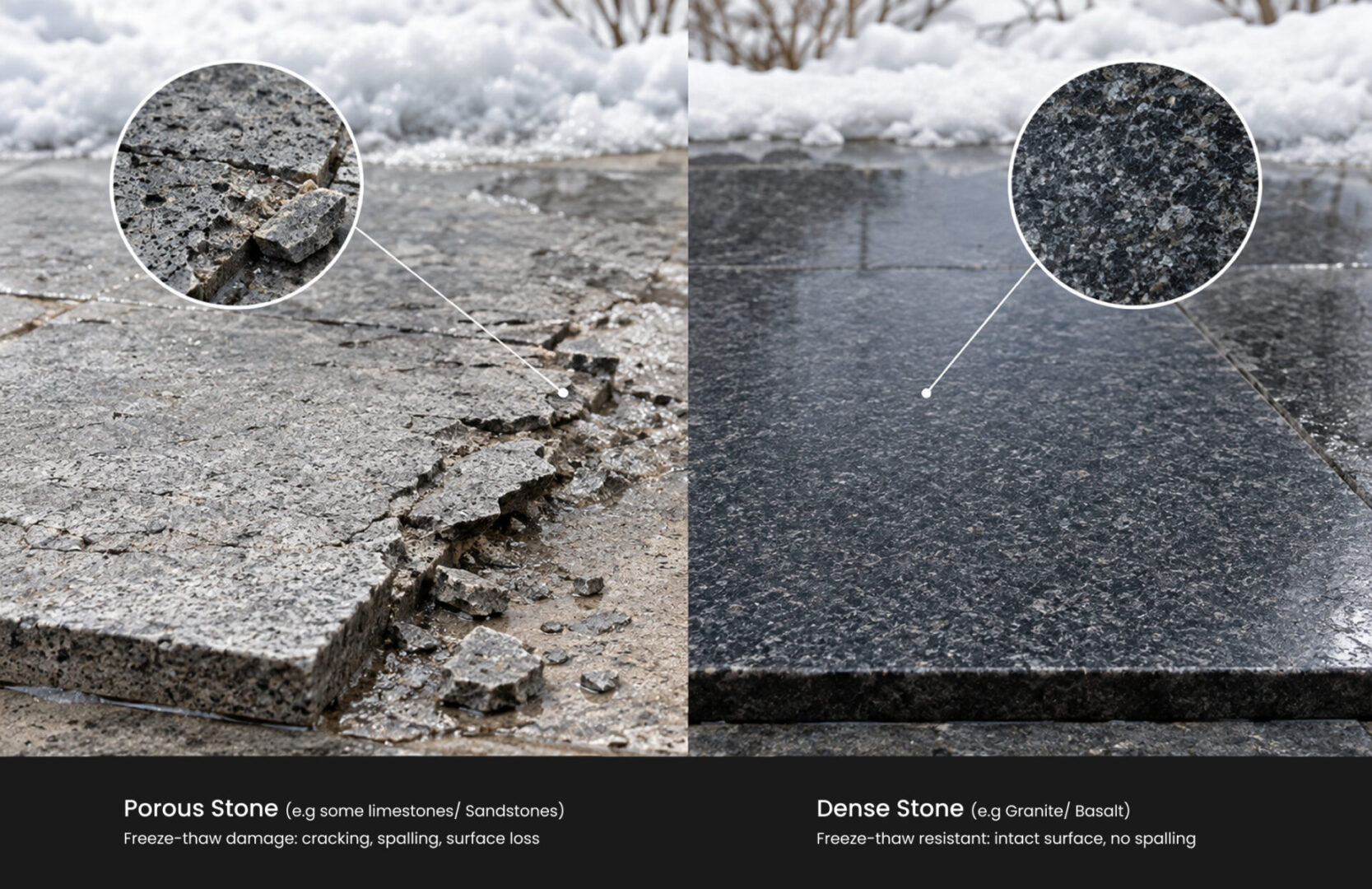
Basalt’s water absorption typically runs 0.1–0.8% depending on grade. Our densest basalt products, Black Basalt tile and pavers, test as low as 0.09–0.2%. Granite typically runs slightly higher, in the 0.1–0.5% range across most of our product line. Only the very densest premium granites, like Zorra at 0.01–0.16%, match basalt’s best figures.
Lower water absorption matters most in freeze-thaw climates. Water that penetrates a stone’s pores expands when it freezes, gradually cracking or spalling the surface over repeated winters. Basalt’s generally tighter, denser structure gives it a modest but real advantage here for most standard-to-mid-range products. The very best granites close that gap almost entirely, though.
Abrasion Resistance and Wear Over Time
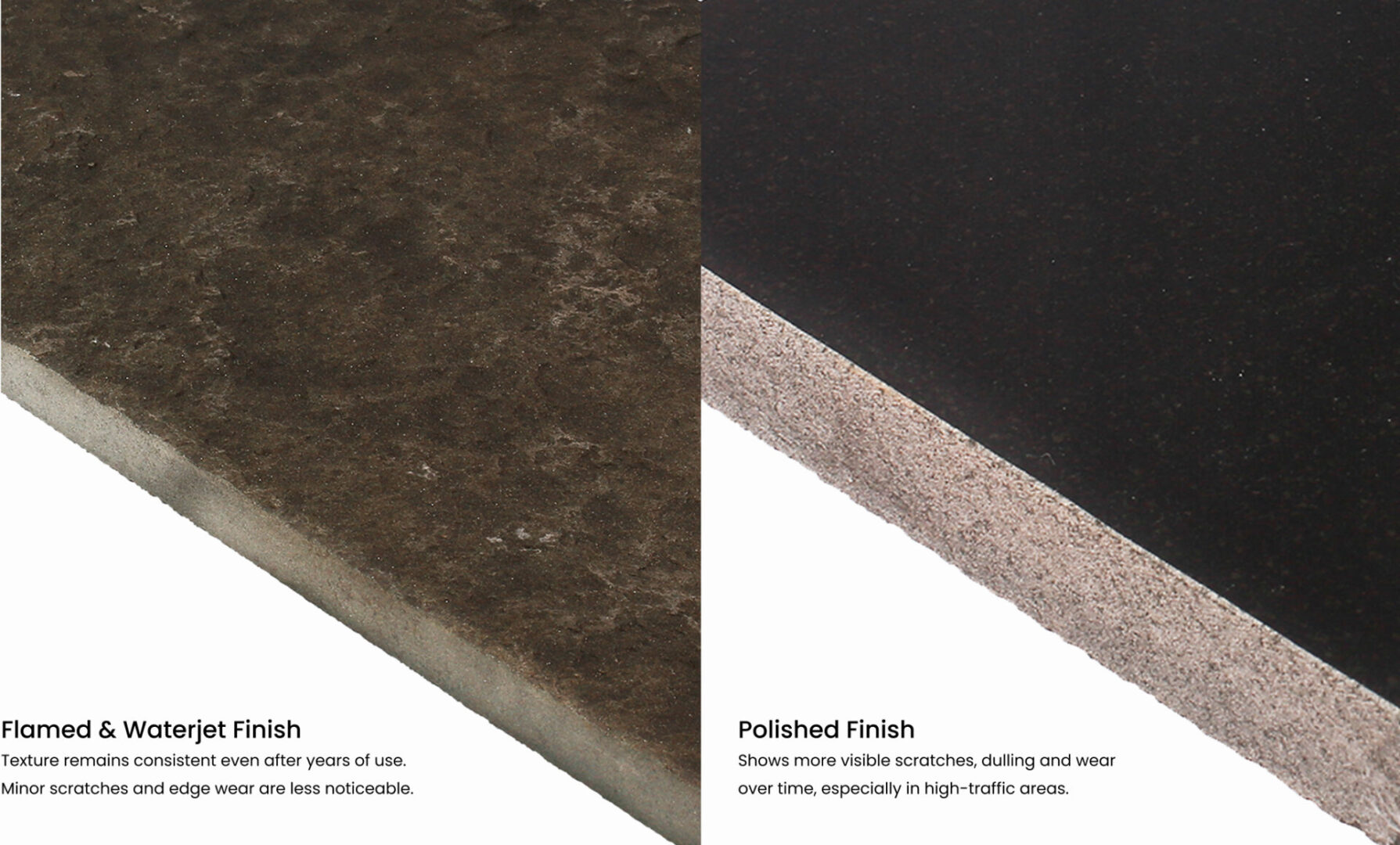
Abrasion resistance (how well a stone resists surface wear from repeated foot or vehicle traffic) is tested under ASTM C241 and applies to both stone types. Both basalt and granite perform well here, and in practice, the finish matters more than the underlying material: a flamed or bush-hammered surface on either stone hides wear and maintains texture far better than a polished surface on either stone, which will show scuffing and dulling over time regardless of which material sits underneath it.
Granite has a slight structural advantage in one specific sense: because granite is coarser-grained, very heavy, sustained abrasion can eventually reveal individual mineral grains at the surface. Basalt’s fine, uniform grain doesn’t show wear this way — it tends to dull more evenly rather than developing a visibly different texture. Neither effect is significant within a normal residential or commercial service life, but it’s a real, minor distinction worth knowing.
Density and Structural Stability
Basalt is generally the denser of the two, typically 2,800–3,100 kg/m³. Granite runs more commonly at 2,600–2,750 kg/m³, though premium black granites can reach 2,950–3,100 kg/m³, matching basalt’s density closely. Higher density generally correlates with greater structural stability and resistance to chipping at edges and corners. That’s part of why very dense basalt and premium black granite both remain popular choices for high-traffic commercial paving and stair treads specifically.
Where Basalt Tends to Win
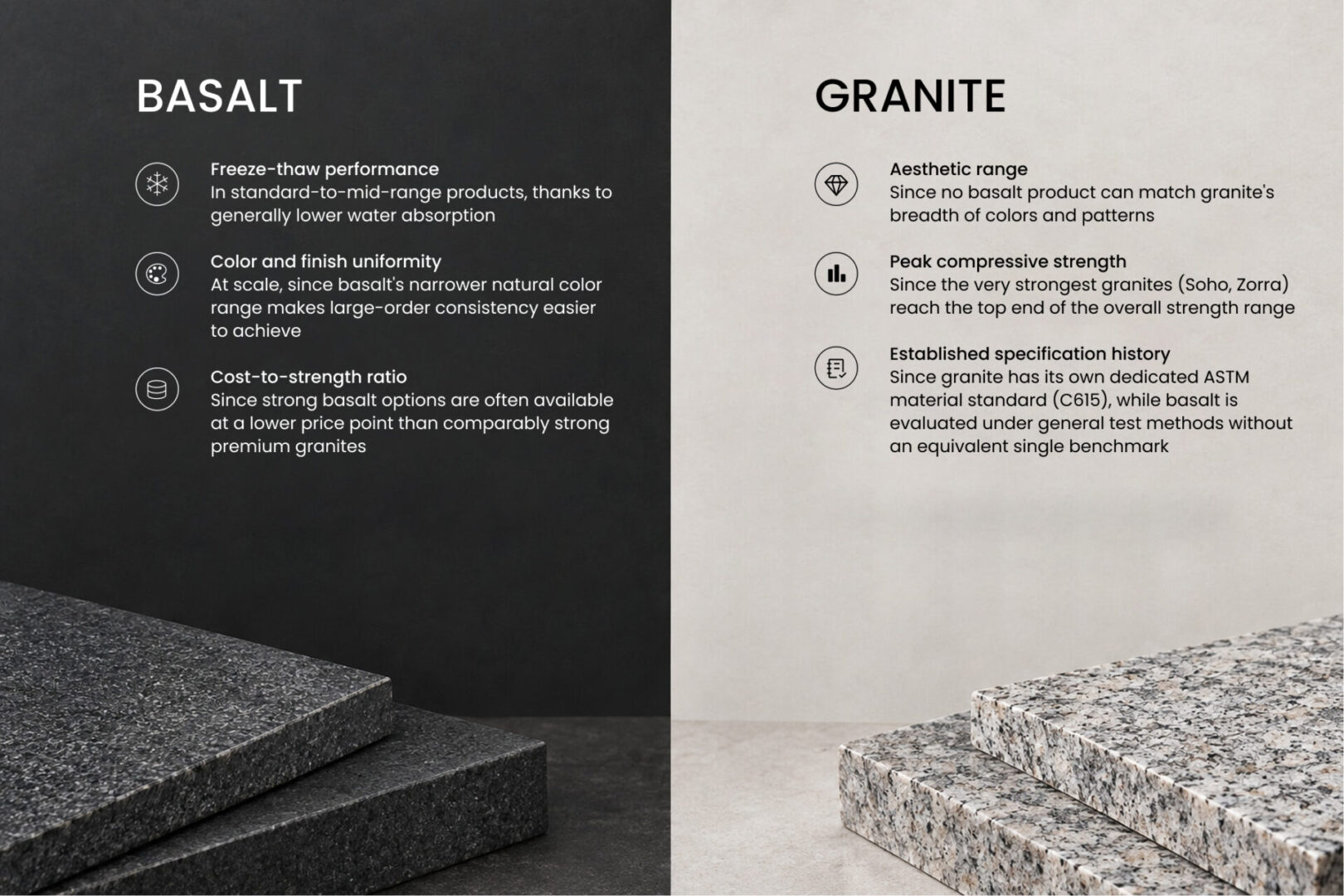
- Freeze-thaw performance in standard-to-mid-range products, thanks to generally lower water absorption
- Color and finish uniformity at scale, since basalt’s narrower natural color range makes large-order consistency easier to achieve
- Cost-to-strength ratio, since strong basalt options are often available at a lower price point than comparably strong premium granites
Where Granite Tends to Win
- Aesthetic range, since no basalt product can match granite’s breadth of colors and patterns
- Peak compressive strength, since the very strongest granites (Soho, Zorra) reach the top end of the overall strength range
- Established specification history, since granite has its own dedicated ASTM material standard (C615), while specifiers evaluate basalt under general test methods without an equivalent single benchmark
What This Means for Your Project
Planning a driveway, patio, or commercial plaza in a freeze-thaw climate? Either stone performs well, but request the specific water absorption figure for the exact product you’re considering rather than assuming based on material type alone. If color and pattern variety matter as much as raw strength, granite’s range gives it a practical edge. When a project calls for a uniform, modern dark aesthetic combined with top-tier freeze-thaw performance, a premium basalt like our Black Basalt line is difficult to beat on paper.
FAQ
Is basalt harder than granite?
Both fall in a similar hardness range (basalt 5–7 Mohs, granite 6–7 Mohs), so neither is consistently harder. In practice, the specific grade matters more than the general material type.
Which stone is better for a driveway in a cold climate?
Both perform well, but basalt’s generally lower water absorption gives it a modest edge for freeze-thaw resistance in standard-to-mid-range products. The very densest premium granites close this gap almost entirely.
Does a higher compressive strength number always mean a better stone?
Not necessarily beyond the threshold your application actually requires. Both basalt and granite comfortably exceed the compressive strength needed for standard paving and cladding; beyond that point, other factors like color, finish, and cost usually matter more for the final decision.
Why does granite have such a wide range of colors while basalt doesn’t?
Granite’s coarse-grained structure forms from a more varied mix of minerals (quartz, feldspar, mica) crystallizing slowly, producing wide color variation. Basalt cools too quickly for large mineral grains to form, resulting in a much narrower, more uniform charcoal-to-black color range.
Should I always request certified data before choosing between basalt and granite?
Yes, especially for projects with specific engineering or freeze-thaw requirements. Published ranges are useful for initial planning, but the actual performance of the specific stone you order can vary meaningfully within those ranges.
CONTACT OUR TEAM FOR PRODUCT INFORMATION, SAMPLES OR PRICING
